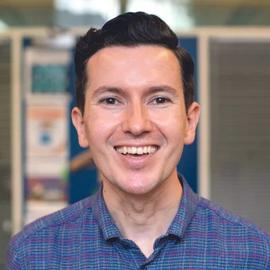
Aron Walsh
CSO at CuspAI and Professor in Materials Design at Imperial College London
Aron Walsh is a Professor and Fellow of the Royal Society of Chemistry (FRSC) in the Department of Materials, where he leads the Materials Design Group. He is Research Area Lead for Modelling & Simulation at the Henry Royce Institute, and Chief Scientific Officer at CuspAI. He has served as an Associate Editor for the Journal of the American Chemical Society (JACS), covering artificial intelligence.
His research involves cutting-edge materials theory and machine learning applied to problems across solid-state chemistry and physics, including materials for solar cells and fuels, batteries, thermoelectrics, and solid-state lighting. He has expertise in semiconductor and dielectric theory and is developing approaches for materials data, informatics, and design. These activities have been supported by funding from the Royal Society, EPSRC, and the European Research Council.
Aron was awarded the EU-40 prize from the European Materials Research Society and the Philip Leverhulme Prize in Chemistry. He received the Corday-Morgan Prize from the RSC for his contributions to computational materials chemistry. He was elected to Academia Europaea in 2025, and features in the Highly Cited Researchers list.
MultimodalAI'26 Keynote Title: Materials on Demand
MultimodalAI'26 Keynote Abstract: The inverse design problem (given a target property or function, identify the optimal material) represents one of the central challenges in materials science. The landscape of materials theory and simulation is addressing this problem through the integration of new techniques and tools from the artificial intelligence (AI) community. Progress in hardware, including classical supercomputers and emerging quantum computers, alongside software advancements incorporating advanced algorithms and statistical machine learning models, is expanding what is now possible. A particular opportunity lies in multimodal AI, which can bridge heterogeneous data streams spanning computation, synthesis, and characterisation to build richer and more transferable representations of materials. Recent developments, such as large language models and generative diffusion techniques, are unlocking application areas ranging from multimodal characterisation to integration with self-driving laboratories. I will survey the evolution of data-driven approaches to materials on demand, highlighting their potential to expedite the identification of compounds essential for the next generation of clean energy technologies. The talk will close with reflections on the translation of academic research into emerging industry, with particular attention to the growing AI-for-materials ecosystem.